
-
A Look at Virtual Fieldwork: Conducting Virtual; Synchronous Reading Groups
Kayden Allen and Haley Hughes
Kayden Allen, Childhood Education, Haley Hughes, Exceptional Education
Faculty Mentor(s): Professor Selenid Gonzalez-Frey, Elementary Education, Literacy, and Educational Leadership
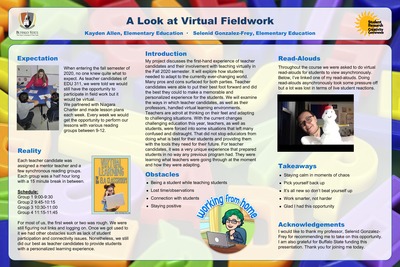
Our project discusses the first-hand experience of teacher candidates and their involvement with teaching virtually during the Fall 2020 semester. It explores how students needed to adapt to the currently ever-changing world. Many pros and cons surfaced for both parties. Teacher candidates were able to put their best foot forward and did the best they could to make a memorable and personalized experience for the students. We examine the ways in which teacher candidates, as well as their professors, handled virtual learning environments. -
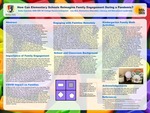
How Can Elementary Schools Reimagine Family Engagement During a Pandemic?
Emily Czarniak
Emily Czarniak, HON400: All College Honors Colloquium
Faculty Mentor(s): Professor Liza Bair, Elementary Education, Literacy, and Educational Leadership
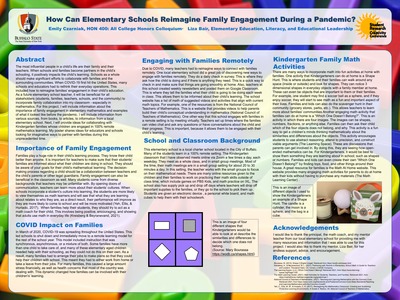
The most influential people in a child's life are their family and their teachers. When schools and families become partners in the child's schooling, it positively impacts the child's learning. Schools as a whole should make significant efforts to collaborate with families and the surrounding communities. When COVID-19 first hit the United States, many schools and educators had to rethink their everyday operations. This included how to reimagine families' engagement in their child's education. As a future elementary school teacher, it will be beneficial for all stakeholders (students, families, teachers, schools, and the community) to incorporate family collaboration into my classroom - especially in mathematics. For this project, I include information about the importance of family engagement in elementary mathematics and examples of what it looked like before the pandemic. I also include information from various sources, from books, to articles, to information from a local elementary school. Finally, I provide ideas for collaborating with Kindergarten families whose children are engaged in 100% remote mathematics learning. My poster shares ideas for educators and schools looking for imaginative ways to partner with families during this unprecedented time. -
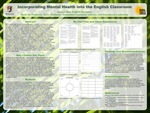
Incorporating Mental Health into the English Classroom
Jessica Wier
Jessica Wier, HON400: All College Honors Colloquium
Faculty Mentor(s): Professor Pixita del Prado Hill, Elementary Education, Literacy, and Educational Leadership
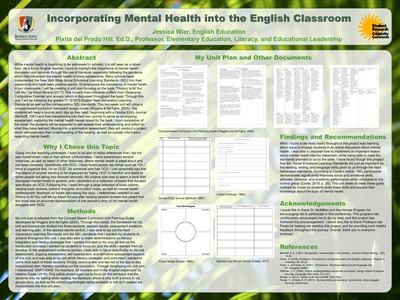
While mental health is beginning to be addressed in schools, it is still seen as a taboo topic. As a future English teacher, I want to highlight the importance of mental health discussion and services through the use of literature, especially following the pandemic which has influenced the mental health of many adolescents. Many schools have implemented the New York State Social Emotional Learning Standards (SEL) into their classrooms and have seen positive results. To emphasize the importance of mental health in our classrooms, I will be creating a unit plan focusing on the book, "History Is All You Left Me," by Adam Silvera. This novel's main character suffers from Obsessive Compulsive Disorder and anxiety, which is discussed throughout the book. Through this Unit, I will be following the grades 11-12 English Next Generation Learning Standards as well as the corresponding SEL standards. This two-week unit will utilize a concept-based curriculum backward design model (Wiggens & McTighe, 2005). The students will keep a journal each day as they read, beginning with a Double Entry Journal (Berthoff, 1981) and then transitioning into their own journal to serve as an ongoing assessment, exploring the mental health issues raised by the book. Upon completion of the novel, the students would be expected to self-assess their understanding and reflect on what they have learned. Moving into a summative assessment, they would conduct a project which demonstrates their understanding of the reading, as well as outside information regarding mental health.
Printing is not supported at the primary Gallery Thumbnail page. Please first navigate to a specific Image before printing.