-
Meaning Making: The Impact of COVID-19 on Residential Graduate Assistants
Alyssa Krawczyk
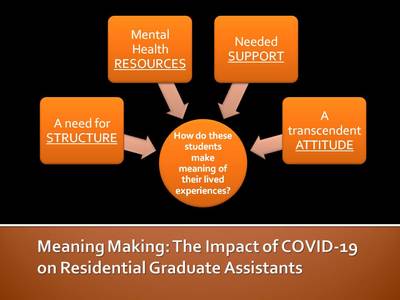
The COVID-19 pandemic has shifted the way that individuals have lived their lives. For most individuals, there has never been an experience in their lifetime that involved a global pandemic. For students in higher education, education was disrupted and altered to maintain health and safety of the public. Students enrolled in a graduate program who serve as graduate assistants have faced many challenges as a result of working towards finding creative ways to engage students virtually, while staying engaged in their full-time virtual coursework. The intention of this study is to examine the impact that COVID-19 has had on these students, and how graduate students and assistants are finding meaning through the experience of learning and working through a pandemic.
-
Study Abroad and Changing Student Needs
Dan Scanlon
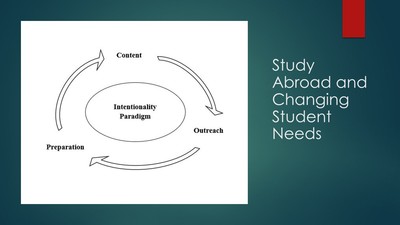
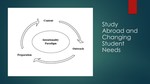
Despite a dramatic increase in access to the global community fostered by technological advancement, institutions of higher education have yet to address the deeper causes of inequities in student participation rates in study abroad programs across student demographics. Although availability of funding plays a significant role, this study examines additional factors that contribute to lower participation rates of historically excluded students (HES) in study abroad programs, defined as first-generation and members of racial minority communities. Significant factors contributing to inequities included decreased social and cultural capital, and a lack of attending to diverse identities of HES. The study explores the potential for short-term, faculty-led study abroad programs to address these needs. The qualitative study at a mid-sized institution in western New York state examined faculty familiarity with the process of developing short-term, faculty-led study abroad programs, program content, and the needs of HES as it related to inclusivity. A general consensus among interview participants indicated a critical role of intentionality throughout the process of curriculum development, recruitment outreach, and preparation of students for the study abroad experience as a means of meeting these needs. Intentionality is thus seen as a catalyst for increasing access to these programs and leveling the playing field for more equitable participation rates among HES.
-
Developing a framework to train community in life threatening emergencies (LTEs)
Mirza Noor Ali Baig
ABSTRACT
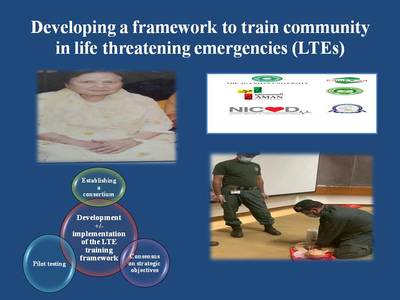
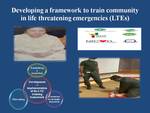
The vision behind my Masters Project is to make Pakistan a nation of life savers. Inspired by my mother’s death due to sudden cardiac arrest I decided to train my community in life saving skills like “CPR” and “Hemorrhage Control” so that they can help save lives by taking appropriate actions and doing immediate interventions. Knowing my passion, I was asked by a professor at my hospital to lead a project where we can develop and implement a framework to train our community in life saving skills like CPR and Hemorrhage Control. To achieve our goal we established a consortium of major stakeholders including the major hospitals, emergency medical services (EMS) and an NGO, and developed a curriculum to train 10 million Pakistani citizens in these life saving skills. Although we want to incorporate this curriculum in schools, the current pandemic has posed certain challenges like lockdowns due to which we are not able to test this curriculum with our intended population. Hence we decided to test our curriculum with the non-clinical staff from the hospitals of our consortium including the security and Human Resource (HR) staff. We have collected their valuable feedback so that we can refine our curriculum before this will become a part of the national school curriculum in Pakistan. Although it is an ongoing process, we are hopeful that once the pandemic is over we will be able to train our community in these life saving skills and make Pakistan a nation of life savers.
Keywords: Training framework, Curriculum, Community, CPR, Hemorrhage Control
Printing is not supported at the primary Gallery Thumbnail page. Please first navigate to a specific Image before printing.